Practical AI Use Cases for Small Businesses: Choose and Measure a Pilot
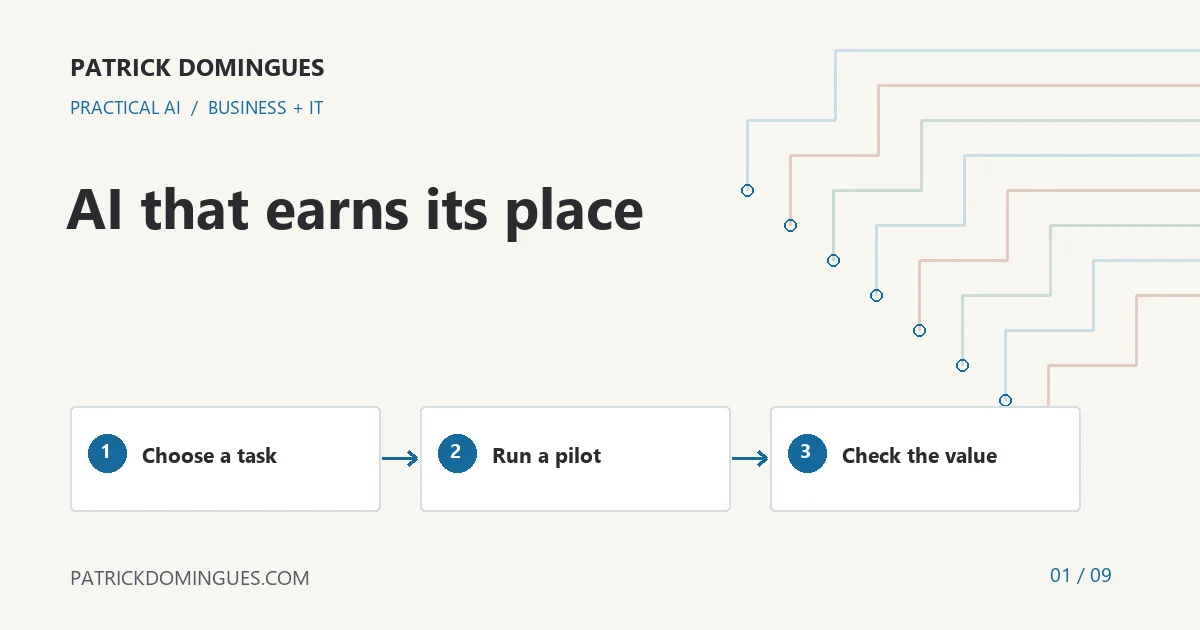
AI is most useful to a small business when it improves a specific task someone already owns. Start with a repeatable piece of work, a source of truth and a way to check the result. Buying a tool before choosing the workflow makes it harder to tell whether it helped.
This guide gives owners and managers a practical way to select a first pilot. The examples are illustrative, not claims about measured results at a particular company.
Five useful starting points
- Draft a response to a common customer question using an approved FAQ. A staff member verifies the answer and sends it.
- Turn rough process notes into a draft operating procedure. The process owner checks every step before adoption.
- Summarize a meeting into decisions, named action owners and unanswered questions. Participants confirm the record.
- Categorize incoming requests so the right team can review them. Billing, security and unusual requests have an explicit escalation route.
- Prepare an outline or first draft from approved public marketing material. A reviewer checks claims, prices, permissions and tone before publication.
Choose a task where a draft is valuable and mistakes are easy to identify before anything reaches a customer. Decisions about employment, credit, health, legal rights or irreversible payments need a different level of assessment and qualified oversight.
Score the task before choosing a tool
Write down how often the work happens, how long it takes, what data it needs and what a mistake would cost. Also ask whether a checklist, template or ordinary automation would solve the problem more predictably.
A good first pilot has a clear input, a bounded output, an available reviewer and an easy way to stop. A poor first pilot asks an assistant to make decisions across every system the business uses.
Use this selection prompt with fictional or approved information:
Help compare these three tasks for a small-business AI pilot:
1. Draft replies from our approved public FAQ.
2. Automatically approve supplier bank-detail changes.
3. Turn internal process notes into a draft SOP.

For each, list the input, intended output, reviewer, possible harm,
data needed and a simpler non-AI alternative. Identify missing facts.
Do not assume any task is approved or estimate savings without data.
The useful result is a comparison that exposes unknowns. It should not present the payment-change task as safe simply because it happens frequently.
Establish a baseline and a pass condition
Pick a small representative sample before using the assistant. Record the time and quality of the current process. Include difficult and ambiguous cases, not only easy examples selected after seeing good results.
For a customer-reply pilot, a pass condition might require every product claim to match the FAQ, no invented refund promise and a reviewer confirming the final response. Keep a separate route for a question the FAQ cannot answer.
NIST’s AI risk guidance is useful for thinking about purpose, affected people, measurement and accountability. Its voluntary Playbook is a resource to adapt, not a certification checklist that guarantees a successful pilot.
Count review and rework in the result
Suppose a fictional task originally takes 10 minutes. An AI-assisted draft takes 3 minutes and review takes 4. The net reduction is 3 minutes, not 7. At 40 tasks a week, that would be 120 minutes before training, administration, subscriptions and correction costs.
Those numbers are an arithmetic example, not a forecast. Measure the actual pilot and compare error rates, escalations and customer impact as well as time. Time saved is not automatically cash saved or additional revenue.
Keep the pilot bounded
Approve the product, account type and data use before staff upload information. Decide who can access retained prompts and responses, how long records are kept and who handles an incident. Avoid pasting customer records into a personal account merely because the task seems routine.
Run the pilot as a draft-and-review workflow. Give it a review date and an owner who can stop it if quality deteriorates or the provider changes a relevant feature.
Choose the next practical step
For a first workflow, try drafting a usable SOP or triaging customer and support requests. Establish the rules with the small-business AI acceptable use template.
Explore the Artificial Intelligence pillar for the full learning path.
Primary references